
Azerbaijan runs an electronic visa programme called ASAN viza, launched in 2017. Applications are handled by VFS Global, the sole official partner, at azerbaijan.vfsevisa.com. For most tourists, the standard e-visa costs €31 all-in and is approved within three working days. Rules vary by passport — around 100 nationalities qualify for the e-visa, about 20 can enter visa-free, and a few still need an embassy application.

This page covers the full ASAN e-visa process for tourist trips — who’s eligible, what it costs, what documents you need, how long it takes, and what happens at the border. If you’re a citizen of a country with its own quirks — the US, UK, UAE residents, Indian passport holders — see the nationality-specific pages linked at the bottom.
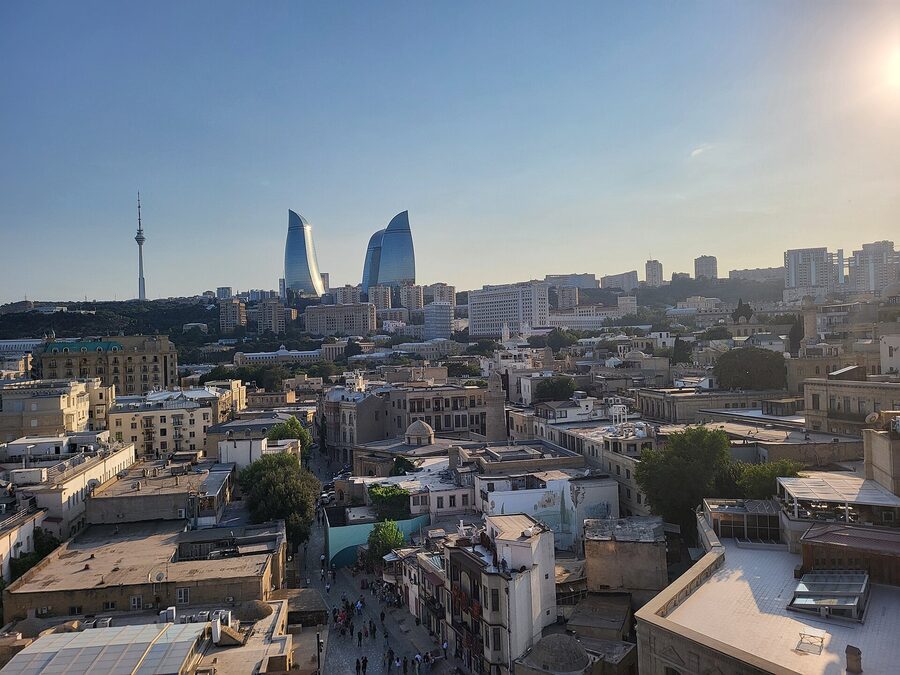
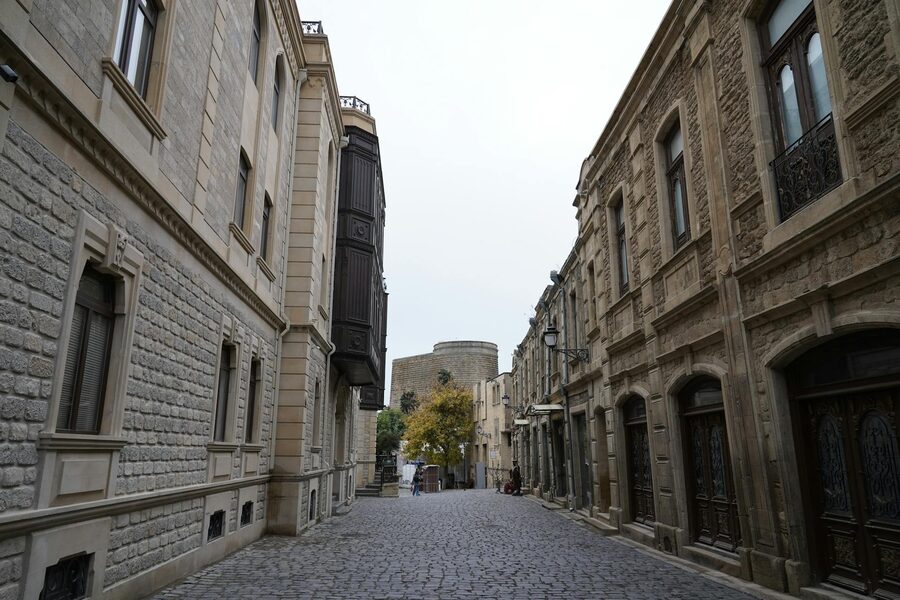
One thing before the paperwork: apply only through the official channels — the government portal evisa.gov.az or the VFS-run azerbaijan.vfsevisa.com. Everything else is a reseller adding margin. And once the visa lands, the planning gets more fun — for Old City walks and mud-volcano day trips, start with this shortlist.
Can you apply for the ASAN e-visa?
Azerbaijan splits visitors into three buckets, and which one you’re in decides whether you apply at all.
Visa-free (no application needed)
Around 20 countries — the CIS states, Turkey, Serbia, Qatar, and a few others — can enter Azerbaijan without a visa. If you’re on this list, you skip the application entirely and arrive with just a valid passport. Check your nationality against the current exemption list on VFS’s information page before you book; the list changes from time to time.
Eligible for the ASAN e-visa
Roughly 100 countries qualify for the electronic visa, including the US, UK, Canada, Australia, India, Pakistan, most of the EU and Schengen area, and much of Southeast Asia. If your passport is on the e-visa list, you apply at azerbaijan.vfsevisa.com — that’s what this guide walks through.
Embassy-only applications
A small number of countries can’t use the e-visa system and must apply in person at an Azerbaijani diplomatic mission. Sticker visas are also required for long-stay purposes — work, study, or stays over 30 days — regardless of nationality.
Fees, stay length, and validity
The ASAN e-visa is single-entry only and valid for a maximum stay of 30 days. You can’t extend it once you’re in Azerbaijan — for longer stays you need a traditional embassy visa, or you leave and re-enter on a fresh e-visa (though back-to-back re-entries tend to draw questions at the border, so it’s not a reliable workaround).
Two application tiers, priced in euros and non-refundable either way:
- Standard: €25 visa fee + €6 VFS service fee = €31 total, processed within three working days.
- Urgent: €51 visa fee + €6 VFS service fee = €57 total, processed within three hours during working hours.
Upgrading to urgent costs you an extra €26. The urgent tier genuinely works — approvals regularly land inside 90 minutes even during holidays — but it’s only worth paying double if your flight is inside 48 hours and you haven’t heard back yet. €31 for a single-entry 30-day visa is on the higher end for a regional e-visa, but it’s been priced at this level since the programme launched, so there are no surprises.

What you need before you start
Have these ready when you open the application form:
- A passport valid for at least six months from your date of arrival in Azerbaijan, with at least one blank page for the entry stamp. If your passport is close to expiry or fully stamped, renew first.
- A clear scan or photo of your passport’s bio-data page. Format: JPEG or JPG only, file size up to 1 MB. The portal rejects anything outside that spec.
- A passport-style photo — plain light background, head and shoulders, no glasses or hats.
- A Visa, Mastercard, or Maestro credit or debit card with 3D Secure enabled and international transactions active. The card doesn’t have to be in the applicant’s name, which helps if you’re paying for a partner or a parent’s application. Amex is not accepted.
- An email address you’ll actually check — the approval arrives as a PDF attached to a confirmation email, and if it lands in spam you’ll miss your own visa.
You don’t need to upload hotel bookings, return flights, or bank statements. The form asks you to declare accommodation and travel dates but doesn’t require uploaded proof — that’s the main simplification versus the embassy process. Every traveller, including infants and children, needs their own individual e-visa; there’s no family application.
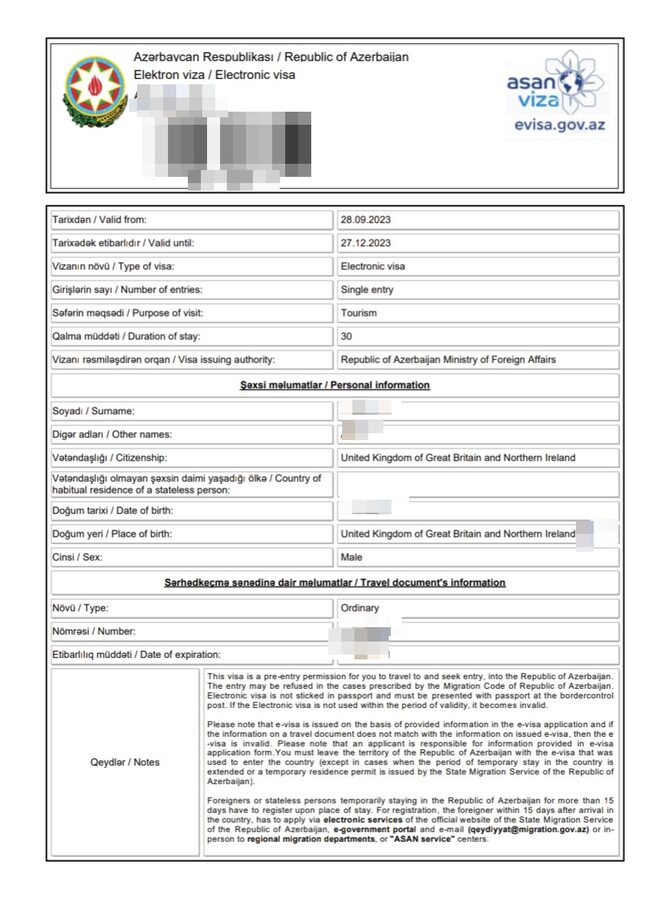
How to apply — step by step
- Go to azerbaijan.vfsevisa.com and register an account. The portal is in English.
- Select the country on your passport. If you hold dual nationality, pick the passport you’ll actually travel on — the e-visa is bound to that specific passport and invalid with any other document.
- Enter your personal and passport details exactly as they appear on the bio-data page. Once the e-visa is processed, the information can’t be changed, so double-check names, accents, and passport number.
- Choose your travel dates — arrival and planned exit. The 30-day window starts on the day you enter Azerbaijan, not the day the visa is issued.
- Upload your photo and passport bio-data page scan — JPEG or JPG, up to 1 MB each.
- Pick Standard (€31) or Urgent (€57) at the payment step.
- Pay with Visa, Mastercard, or Maestro. The gateway requires 3D Secure — if your card doesn’t support it, the payment will fail at the bank step, not at checkout.
- Wait for the approval email. You’ll get an immediate confirmation of submission, then a second email with the visa PDF once it’s approved.
- Print the e-visa PDF and carry it with you. Border officers want paper — not every checkpoint accepts a screen copy.
Processing times in practice
The official standard processing time is three working days. In practice, most applications return an approval within one or two working days, and a fair number clear the same day. Weekends and Azerbaijani public holidays don’t count towards the three-day window, so a Friday afternoon submission can effectively take five calendar days to approve.
Apply at least five calendar days before your flight on the standard tier — that buys you a buffer for the occasional application that gets flagged for review. Long holiday periods (Novruz in March, for example) pause standard processing entirely, so if you’re travelling around one of those, either apply well ahead or pay for urgent.
At the Azerbaijani border
On arrival at Heydar Aliyev International Airport (or whichever border crossing you use), present the printed e-visa alongside your passport to the immigration officer. They’ll scan both, stamp your entry date into the passport, and wave you through. The 30-day clock starts on that entry date.
If you’re staying longer than 15 days, you must register your address with the State Migration Service within those first 15 days of arrival. Most hotels handle this automatically when you check in — it’s worth asking at the front desk to confirm. If you’re staying at an Airbnb or with a friend, the registration is on you, either through the electronic service at migration.gov.az or in person at a migration office.
If your application is refused
Refusals are uncommon for straightforward applications but they do happen. The usual reasons:
- Passport validity short of six months from arrival, or no blank page for the entry stamp. Fix: renew your passport and reapply.
- Mismatched details between the application form and the passport bio-data page — names, accents, passport numbers. Fix: start a fresh application with exact details. The submitted information can’t be edited after the fact.
- Photo or passport scan outside spec — wrong format, over 1 MB, blurry, or busy background. Fix: reshoot or rescan and reapply.
- Recent immigration issues — a previous overstay, a pending case, or flags in the State Migration Service database.
Both the visa fee and the VFS service fee are non-refundable regardless of outcome. If you reapply, you pay both again. For anything other than a straightforward fix, the escalation path is the Azerbaijani diplomatic mission in your country.
Nationality-specific guides
The process on azerbaijan.vfsevisa.com is the same regardless of passport, but the fees, eligible-nationality lists, and edge cases differ. Dedicated pages for each major applicant nationality are published as we complete them — US, UK, Canadian, Indian, Pakistani, UAE resident — with the specific quirks that apply to that passport. Check the footer country list for what’s live.
Common questions
Is the ASAN e-visa the same as a visa on arrival?
No. The ASAN e-visa is issued before you travel, at azerbaijan.vfsevisa.com, and you arrive in Azerbaijan already approved. A small number of nationalities — UAE residents, GCC permanent residents, and a few others — can also obtain a 30-day visa on arrival at the airport. The two systems run in parallel; the e-visa is the right path for most tourists.
My passport expires six months after my return flight. Can I apply?
The requirement is six months of passport validity from your date of arrival in Azerbaijan, not six months from your return flight. If you land on 1 August, your passport must be valid until at least 1 February. If it isn’t, renew first.
Can I extend my 30-day stay once I’m in Azerbaijan?
Not on the e-visa. For longer stays, you need a traditional visa issued by an Azerbaijani embassy before you travel. Some visitors exit to a neighbouring country and re-enter on a fresh e-visa, but this draws scrutiny at the border and isn’t a reliable strategy for multi-month stays.
Do I need to book flights and hotels before applying?
The application asks you to declare your accommodation address and travel dates, but it doesn’t require uploaded booking confirmations — that’s the embassy process. Most applicants enter their first-night hotel as the accommodation address. If your plans change after the visa is issued, that’s fine; you’re not locked into the declared itinerary.
I’m a US citizen — can I still get a visa on arrival at Baku airport?
Not any more. Until 2024, US passport holders could get a 30-day visa on arrival if they flew direct from New York. No airline currently runs the JFK–Baku route, so the on-arrival option is effectively closed for Americans. Apply for the e-visa before your trip.
Can I pay with my partner’s or parent’s card?
Yes. The card used for the fee doesn’t have to be in the applicant’s name. It does need to be Visa, Mastercard, or Maestro with 3D Secure enabled and international transactions active. If the payment fails and you see a 3D Secure prompt, that’s the issuing bank — complete the challenge (usually an SMS or app push) and the payment goes through.
Can I apply on behalf of my partner or family?
Yes, though each traveller — including children and infants — needs an individual application. You can submit several in sequence from the same account and pay for all of them with one card. Each applicant gets their own approval email and PDF. You do need each person’s full passport details and a usable photo file to hand.
What happens if I overstay?
Overstaying an Azerbaijani visa risks a fine on exit (scaled by how long you overstayed), a re-entry ban of one to five years, and a flag in the State Migration Service database that will complicate future applications. If you realise you’ll overstay, contact the State Migration Service office in Baku before the visa expires — asking about a permitted extension or voluntary departure is a much better outcome than being caught at the border.
Reviewed 23 April 2026 against the official Azerbaijan e-visa programme at azerbaijan.vfsevisa.com (VFS Global, sole authorised partner). If you spot something out of date, let us know on the Contact page.